Every Indian household has an opinion on this. One side swears by the kitchen: multani mitti from the local store, besan, haldi, and dadi's exact ratios. The other side wants a tube or pouch that just works.
Most articles on this topic are secretly ads for one side. This one is not. Here is a fair comparison of homemade vs readymade face packs, so you can pick what suits your life.
What Makes a DIY Multani Mitti Face Pack So Popular?
Let us give DIY its full due, because it has real advantages.
It is very cheap per use
A 100g packet of loose multani mitti costs a fraction of any branded product and yields many applications. If you use face packs regularly and buy in bulk, nothing beats DIY on cost per use. This is the single biggest reason it remains popular, and it is a completely valid one.
It is fully customisable
Your skin, your recipe. Extra oily this week? Add a little more clay. Feeling dull? Add a pinch of orange peel powder. Want a soothing version? More rose water, shorter time. DIY gives you control that no fixed formula can match, and experienced users genuinely benefit from this flexibility.
You know what is going in
When you mix it yourself from ingredients you trust, there are no hidden preservatives, fragrances, or fillers. For people who react to unknown ingredients, this transparency is valuable.
A simple, reliable DIY recipe: two spoons of multani mitti, enough rose water to form a smooth curd-like paste, applied for 10 to 15 minutes on clean skin. That is it. Skip the lemon juice that many recipes suggest; it is acidic and harsher on skin than most people realise.
Where Does DIY Quietly Fail?
Now the other half. DIY's problems are not about the recipe. They are about everything around the recipe.
Storage ruins bulk ingredients
Clay powders are hygroscopic, meaning they absorb moisture from the air. That open packet of multani mitti in a humid Indian bathroom slowly clumps, hardens, and degrades. One wet spoon dipped into the jar can introduce bacteria that grow quietly over weeks. We wrote a full guide on this in how to store multani mitti, because it is the most ignored part of DIY skincare.
Dosing is guesswork
"Two spoons" of powder and "some" rose water gives you a different paste every time: sometimes too runny, sometimes too thick, often more than you need. The leftover gets stored "for tomorrow", which is a hygiene problem, or thrown away, which quietly eats into that cost advantage.
The mess and effort add up
A bowl, a spoon, measuring, mixing, and cleaning up afterwards. It sounds small, but it is exactly why so many jars of multani mitti sit unused after the first month. A face pack that is too much effort is a face pack you skip.
Are Ready-Made Face Packs Actually Better?
Ready-made packs solve the problems above, but the category has its own trap, so let us be precise.
Where ready-made formats win
Consistency and dosing: the ratio is fixed by the maker, so every application behaves the same. Hygiene: a sealed product has never met your bathroom's humidity or a wet spoon. Convenience and travel: no bowl, no mixing station, no cleanup. For busy people, this is the difference between using a pack weekly and not using it at all.
Where you must read the label
Many mainstream cream-based packs stay soft in the tube for two years because of preservatives, and some add fragrance and colourants. That is not automatically dangerous, but it is a real trade-off against the DIY promise of pure ingredients. If you buy ready-made, check the ingredient list, not just the front of the pack.
So the real question is not homemade vs readymade. It is: can you get DIY-level purity with ready-made convenience?
DIY vs Ready-Made: The Quick Verdict
Choose DIY if you use packs very frequently, enjoy the ritual, want full control over recipes, and are disciplined about airtight storage and dry spoons. It is the cheapest path and a perfectly good one.
Choose ready-made if you want consistent results without effort, travel often, share a humid bathroom, or know from experience that a mixing-bowl routine will not survive your schedule. Also lean ready-made if past DIY attempts ended with hardened powder in a forgotten jar.
Whichever you choose, the fundamentals stay the same: clean skin before, 10 to 15 minutes on, moisturiser after, and sensible frequency. We break down the ideal schedule in how often should you use a face pack, and the case for rose water as your mixing liquid in rose water for face.
Can You Get Fresh DIY Quality Without the DIY Effort?
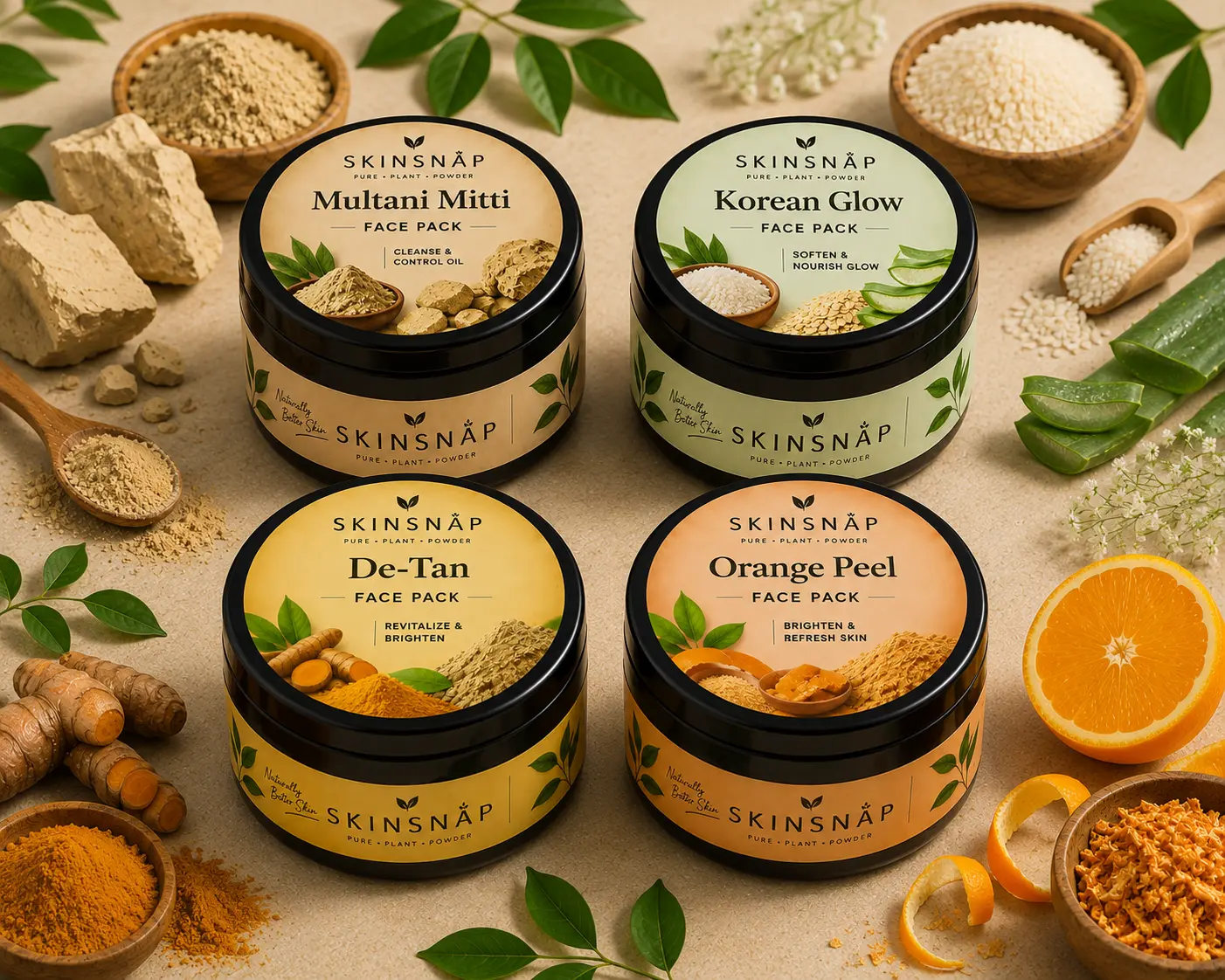
This middle path is exactly why SkinSnap exists. Instead of a pre-mixed cream that needs preservatives, or a vague bulk bag you have to portion yourself, each SkinSnap jar holds 50g of 100% natural face-pack powder — finely milled clay and botanicals, nothing added.
You scoop out one or two teaspoons into a bowl, add a little water or rose water, and mix it into a smooth paste right before you use it. Apply, wait 10 to 15 minutes, rinse. You get a freshly mixed pack every time, with only as much as you need, and one 50g jar makes many packs. Because nothing is pre-mixed, there are no preservatives and no chemicals, just like a good DIY pack — you simply skip the sourcing and grinding.
Single jars start at ₹399 each, and the more packs you buy the less each one costs, while the ₹749 Combo Pack includes all four variants: Multani Mitti for oil control, Orange Peel for brightening, De-Tan for tan removal, and Korean Glow for a healthy glow.
DIY purity, ready-made convenience. You no longer have to pick a side.
Frequently asked questions
Neither is automatically better. Homemade packs are cheaper per use and fully customisable, while good readymade packs win on hygiene, correct dosing, and convenience. The best choice depends on whether you have the time and storage discipline that DIY demands.
Mix about two spoons of multani mitti powder with rose water until you get a smooth, curd-like paste. Apply on clean skin, leave for 10 to 15 minutes until mostly dry, and rinse off. Always use a clean dry spoon and use the paste immediately after mixing.
Common reasons are ingredients past their best, contamination from wet spoons or storage, a too-strong ingredient ratio, or lemon juice and similar acidic add-ons that are harsh on skin. Fresh ingredients, gentle ratios, and immediate use reduce most of these problems.
Multani mitti based packs are the most trusted option for oily skin in India because the clay absorbs excess oil and cleans pores deeply. Whether you make it at home or buy a ready format, mixing it with rose water and using it two to three times a week gives good results.
Try it the fresh way
This article is for general skincare information, not medical advice. Always patch-test a new product on your inner arm and wait 24 hours before applying it to your face.